

Burnham's Big Devolution Pitch: Power to the People (But Which People?)
Andy Burnham has wasted no time making his mark as Prime Minister, and devolution is right at the heart of his pitch to the country. His vision — sometimes dubbed a 'Number 10 North' approach to governance — is built on a simple but powerful idea: that power has been hoarded in Westminster for too long, and that communities across the UK deserve a bigger say over their own futures. Think jobs, high streets, local economies — the stuff that actually affects people's daily lives.
Burnham has been refreshingly blunt about why he thinks this matters. According to Scottish First Minister John Swinney, the new Prime Minister openly "acknowledges and accepts that Westminster has failed many parts of the United Kingdom". That's a striking admission from a sitting PM, and it signals a genuine appetite for rethinking how Britain is governed — not just tinkering at the edges.
For English regions, Burnham's agenda is generating real excitement. The promise of deeper devolution, more local control over economic levers, and a shift away from the old top-down model feels like a breath of fresh air. Burnham himself has spoken about devolution's potential to help communities "re-industrialise — creating jobs, transforming high streets and reviving local economies".
But here's where it gets complicated. For Scotland, the mood is decidedly more mixed. Burnham has signalled he will "engage" with Holyrood on further powers, which sounds promising — yet his firm refusal to discuss a second independence referendum means the conversation starts with a significant elephant already in the room. Swinney has welcomed the constructive tone, but uncertainty lingers over just how far Burnham's devolution vision actually extends when it comes to Scotland's specific ambitions.
Independence Off the Table: Burnham's Firm No to a Second Referendum
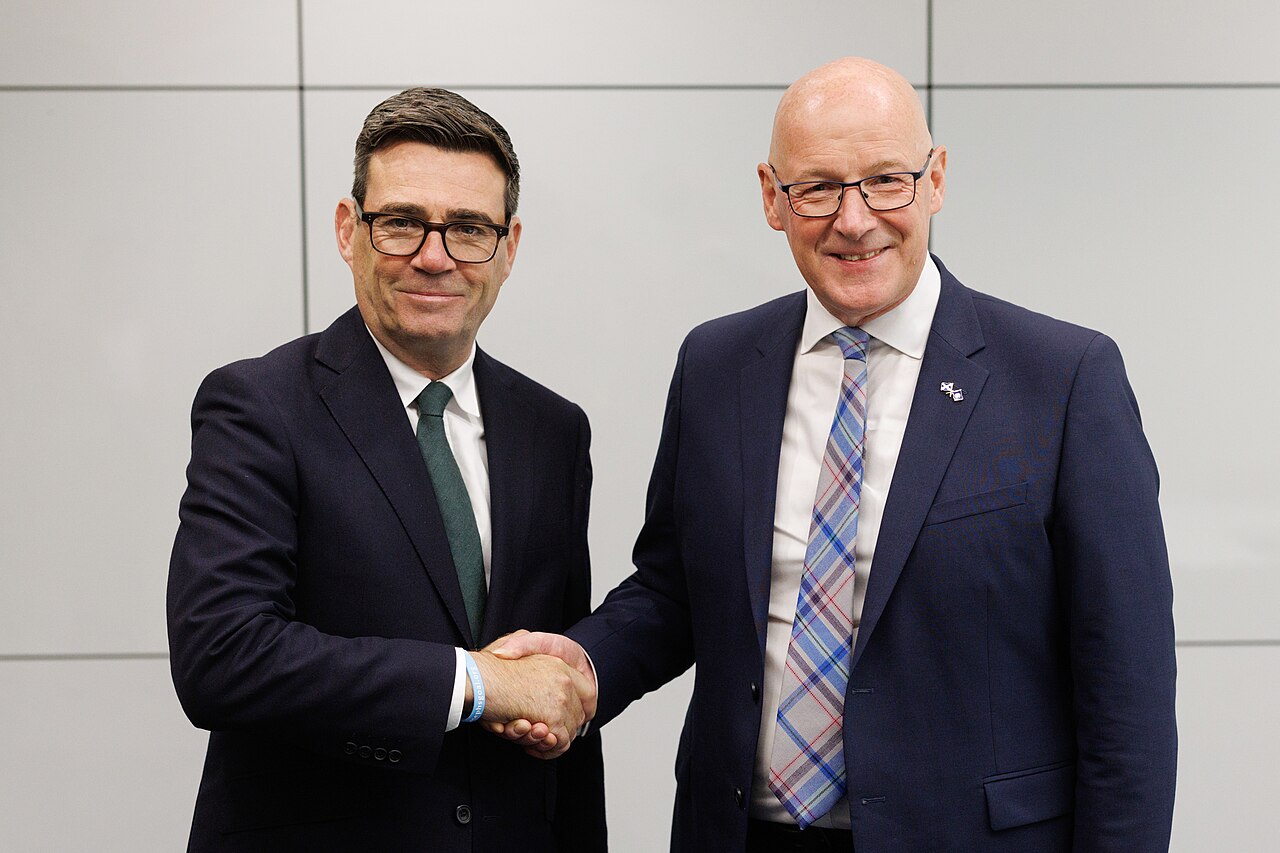
Photo: Simon Dawson / No 10 Downing Street OGL 3
If there's one thing Andy Burnham made crystal clear in his very first week as Prime Minister, it's this: a second Scottish independence referendum simply isn't happening on his watch. In a telephone call with Scottish First Minister John Swinney, Burnham told him bluntly that the two men would have to "agree to disagree" on the matter which is a polite but firm way of saying the door is shut, at least for now.
Burnham's reasoning isn't really about ideology, rather it's about priorities. Speaking ahead of his face-to-face meeting with Swinney in Glasgow, the Prime Minister said: "I'm not focused on point scoring or discussing constitutional changes like referendums, I want practical measures to help people live well and bring back hope." In other words, with the cost-of-living crisis still biting and economic recovery at the top of the agenda, he sees a referendum debate as a costly distraction the country simply can't afford right now.
Swinney, to his credit, didn't pretend the disagreement wasn't there. He openly acknowledged that "the Prime Minister clearly does not agree with me on the question of independence" — but he also wasn't backing down. The First Minister insisted that "the democratic question has got to be answered" and called it a personal priority.
A Record Result That Changes Nothing - Yet
Here's what makes this particularly awkward for Burnham: May's Scottish Parliament elections returned a record number of pro-independence MSPs to Holyrood. That's a significant political signal. The catch? Swinney's SNP fell short of the outright majority he needed to credibly push for a second ballot. It's the kind of result that keeps the independence debate very much alive without quite giving either side a decisive hand to play.
For now, both leaders are choosing to focus on what they can agree on — deeper devolution, economic cooperation, and helping communities rebuild. But with Swinney refusing to let the constitutional question go quietly, this particular disagreement is unlikely to stay politely parked for long.
Scotland Kept in the Dark: SNP and Greens React to Being Sidelined
If you were hoping for a warm, inclusive embrace of Scotland in Andy Burnham's devolution vision, the early signals suggest you might be waiting a while. While Burnham has spoken enthusiastically about reshaping power across the UK, Scottish politicians, particularly those in the SNP and Scottish Greens, are asking a pointed question: where exactly do we fit in?
SNP leader and First Minister John Swinney has struck a carefully diplomatic tone in public, describing his first face-to-face meeting with Burnham as "constructive" and welcoming the new Prime Minister's willingness to "engage" on the possible devolution of further powers to Holyrood. But read between the lines, and the frustration is hard to miss. Swinney pointedly noted that "Westminster has failed many parts of the United Kingdom and has failed Scotland," framing the devolution conversation as one born of necessity rather than generosity.
The SNP's deeper irritation stems from feeling shut out of the process of shaping the agenda, not just reacting to it. There's a big difference between being consulted and being informed — and Scotland appears to have received more of the latter.
Scottish Greens, meanwhile, have been more openly sceptical, voicing concern that Scotland risks being treated as an afterthought in what is fundamentally an England-focused devolution project built around mayors and metro regions.
The Sarwar Elephant in the Room
Adding a layer of awkwardness to all of this is the controversial appointment of former Scottish Labour leader Anas Sarwar to both Burnham's government and the House of Lords — just months after leading Scottish Labour to its worst-ever Holyrood election result. Swinney addressed it with barely concealed amusement, saying it was "of great interest to me, and great amusement, that a recent candidate for first minister finds himself in the House of Lords".
It's the kind of appointment that makes cross-party goodwill significantly harder to build — and it underlines the sense that, for now, Scotland is watching Burnham's devolution story unfold from the outside.
What Burnham's Devolution Model Could Actually Mean for Scotland

Source: commons.wikimedia.org — CC BY-SA 2.0

So what does Andy Burnham's vision for devolution actually look like in practice, and where does Scotland fit into it? The honest answer right now is: it's complicated, and the details are still very much being worked out.
The clearest signal so far came during Burnham's first face-to-face meeting with Scottish First Minister John Swinney, held in Glasgow ahead of the Commonwealth Games opening ceremony. Swinney described the conversation as "constructive," and said the Prime Minister had acknowledged that "Westminster has failed many parts of the United Kingdom and has failed Scotland" which is, at the very least, a notable admission from a new Labour PM.
The two leaders agreed that there were "a number of opportunities for the devolution of further powers to improve the lives of the people of Scotland and across the UK," though no specifics were put on the table. Burnham's broader devolution pitch centres on re-industrialisation, think job creation, reviving high streets, and transforming local economies, which could translate into additional economic levers for Holyrood down the line.
Can 'Constructive Engagement' Actually Go the Distance?
Here's the catch. While Swinney welcomed the tone of the talks, the fundamental tension hasn't gone away. Burnham made it clear the two would have to "agree to disagree" on a second independence referendum full stop. For the SNP, devolution is a stepping stone, not a destination. That gap is enormous, and friendly meetings in Glasgow won't close it on their own.
The Commonwealth Games encounter was symbolically meaningful in that a new PM travelling to Scotland early in his tenure sends a message, but it was also deliberately limited in scope. No firm commitments, no timetable, no list of powers. Just a promise to keep talking.
For now, Scotland's constitutional future feels like it's sitting in a waiting room. Burnham's model may deliver genuine improvements in devolved areas, but for those who want independence, better devolution is not the same as self-determination. The road ahead will depend heavily on whether "constructive engagement" produces real policy changes — or simply becomes a polite way of kicking harder questions further down the road.